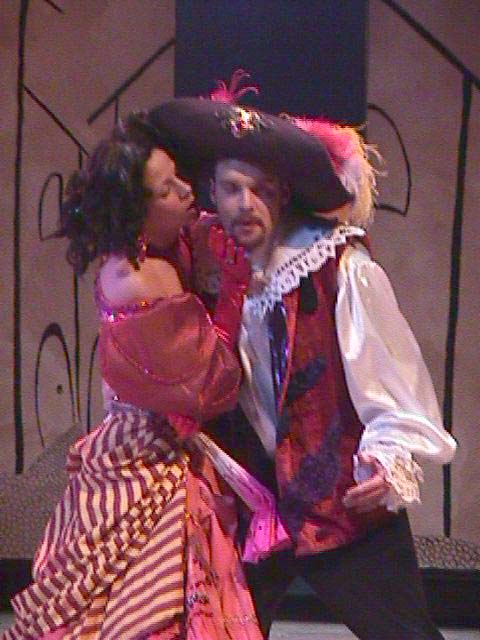
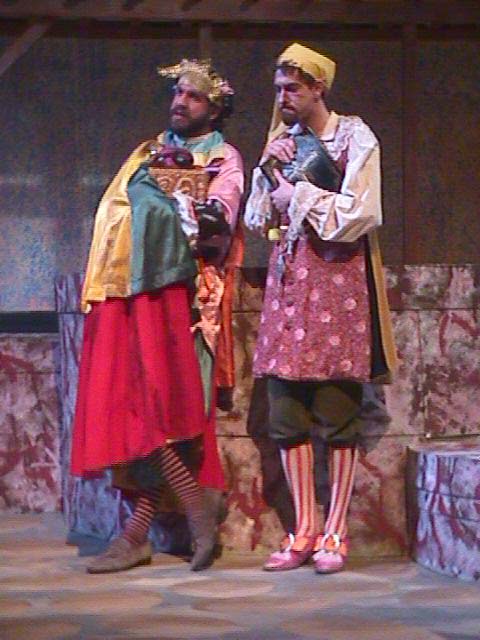
According to Aristotle the tragic hero evokes our pity and terror if he is neither thoroughly good nor thoroughly evil but a mixture of both. The tragic effect is stronger if the hero is more moral than we are. The tragic hero suffers a change in fortune from happiness to misery because of a mistaken act which he performs due to his hamartia-'error of judgment'- one form of hamartia is hubris-'pride' which leads the tragic hero to ignore or violate a divine warning or moral law. The tragic hero evokes our pity because he is not evil and his misfortune is greater than he deserves, and he evokes our fear because we realize we are fallible and could make the same error. It would appear from Aristotle's definition that Oedipus could be described as a tragic hero.
Of course, this topic is discussed more on my Acting, Directing and Script pages.
If you are an actor, forget about everything else, character is your prime responsibility! Because you have to turn in ROLE.
In a conservatory schooling "Character Study" is usually a semester long class; in my classes I approach it from inside (Stanislavsky, Method Acting) and from outside (Biomechanics, Physical Theatre).
When I staged "3 Sisters" by Chekhov, I made a page for each character in the play (it's my translation/adaptation and has less characters than the original). See Shows Directory.
I will explain the chart "Drama: Character" later.
For now, please, take a note of two kinds of text: primary and secondary (stage directions and etc.) Only in combinations of the two we can "read" the subtext!
(c)2004 *
Summary
List character-oriented plays:
2007 -- Stoppard
Questions
Are characters "major" or "minor?"
Shallow or well-drawn?
Extraordinary or ordinary?
Representative or particularized?
List (samples) of stock characters:
The femme fatale, La belle dame sans merci, the Black Widow, the beautiful, but evil woman who leads the hero to his doom.
The Fool: The fool is a clown or joker who speaks in riddles and puns. Often, the fool is intelligent and witty and reveals key truths about the characters he fools with (Shakespeare's fools, such as the ones in Twelfth Night and King Lear, are well-known examples).
The Mad Scientist: The insane man of science, who either accidentally or intentionally "meddles with the forces of nature" and causes the trouble which the hero must correct.
The Sidekick: the Hero's helper, Sancho Panza in Don Quixote, Dr. Watson in Sherlock Holmes.
The Outlaw: sometimes a cold-blooded desperado, but also often a gallant highwayman or a dashing thief after the manner of Robin Hood.
Notes
The commedia dell'arte, with its stock situations and characters and improvised dialogue, has shown the way to many other forms of drama, from pantomime and Punch and Judy - which features debased forms of the commedia characters (see below) - to the modern animated cartoon, situation comedy, and even professional wrestling.
Arlecchino (Harlequin), Venice, an acrobat and clown, he carried a baton which he used to bash other characters, leading to the modern term slapstick. He wore a cat mask, and his ultimate costume, a patchwork of red, green, and blue diamonds is still a fashion motif, though any patchwork costume would be called a harlequin costume. He is a not really villainous, he is just a bit dodgy.
Brighella (Figaro, Molière's Scapin), Bergamo, a money-grubbing villain, a partner of Arlecchino
Columbina (Colombina, the Servant, Columbine, Harlequine, Pierrette), Venice, maidservant to Inamorata and lover of Arlecchino, usually involved in intrigue. She is rather intelligent.
Il Capitano (the Captain), boastful he-man soldier, but a coward underneath
Il Dottore (the Doctor), Bologna, Pantalone's friend, and a quack
Inamorata (the Lover), the leading woman, who wore no mask (see innamorati)
Inamorato (the Lover), the leading man, who wore no mask (see innamorati)-his partner is also called a lover.
Isabella (Lucinda, Cornelia, Silvia, Rosaura), Pantalone's daughter. She is very headstrong, flirtatious, sensuous, and articulate. Men are constantly falling hopelessly in love with her. She loves to tease and test the men. Her father always tries to control her life by arranging meetings and agreements with gentlemen suitors.
Pagliaccio (the Clown), a forerunner of today's clowns
Pantalone (Pantaloon), Bologna, a rich and miserly merchant who is the father of Isabella. He also employs Arlecchino and treats him cruelly.
Pedrolino (or Pierino, Vicenza, and most commonly nowadays known as Pierrot a dreamer with a white mask, now considered the French version of a clown.
Pulcinella, Naples, a hunchback who still chases women, he was the model for Punch in the English variation Punch and Judy.
La Ruffiana (old woman), usually a mother or gossipy townswoman who intrudes into the lives of the Lovers
Scaramuccia (Scaramouche), a roguish adventurer and swordsman who replaced Il Capitano in later troupes. Was the servant for another character. He wears a black velvet mask and black trousers, shirt and hat.
Gianduia, Turin, a well-mannered Piedmontese peasant.
... [ Being on a high intellectual or moral level: elevated, high-minded, moral. See high/low. ]
* Having or showing qualities of high moral character, such as courage, generosity, or honor: a noble spirit.
* Proceeding from or indicative of such a character; showing magnanimity: “What poor an instrument/May do a noble deed!” (Shakespeare).
Noble metal, metals that are resistant to corrosion or oxidation ...
#2 -- Character
Any attribute that defines a human being can define a character. For an actor, much of his/her character definition can be found in the script. Everything a character says tells the actor something - from the things that character thinks about, to their level of intelligence or education, their status in society, or how they feel. Character choices are made by each individual actor, which is why the same role can be interpreted many ways by different actors. Your choices are unlimited, and no choice is wrong (as long as it's not contradicted by the script). The choices you make for your character will make it realistic and interesting.
Oh, a person! Like me!... Here where the IDENTIFICATION begins. I have to understand this guy Hamlet! What is he doing? Why? What's wrong with him? What are his problems? Is he crazy? Don't do it, man!...
When we understand somebody, we become friends...
Plot:
According to Aristotle, the most important -- story could exist even without characters!
"Most simply a character is one of the persons who appears in the play, one of the dramatis personae (literally, the persons of the play). In another sense of the term, the treatment of the character is the basic
part of the playwright’s work. Conventions of the period and the author’s personal vision will affect the treatment of character."
Main Points
Comic and tragic hero: below or above average. (Aristotle)
"Another common term in drama is protagonist. Etymologically, it means the first contestant. In the Greek drama, where the term arose, all the parts were played by one, two, or three actors (the more actors, the later the play), and the best actor, who got the principal part(s), was the protagonist. The second best actor was called the deuteragonist. Ideally, the term “protagonist” should be used only for the principal character. Several other characters can be defined by their relation to the protagonist. The antagonist is his principal rival in the conflict set forth in the play."
Inner conflict > Main character
"Another type of character is the stereotype or stock character, a character who reappears in various forms in many plays."
Modern drama: when character becomes a story (Chekhov), more in Playscript Analysis.
[ see ACTING directories: BioMethod, Biomechanics, Method Acting for Directors ]
Protagonist -- "agon" = struggle; the pro side of the struggle -- often used to refer to the lead character in a tragedy (174).
* Antagonist -- the anti side of the struggle -- often the bad guy, but could be anyone / thing that struggles against the protagonist (174).
* Foil / Counterpart: (174) reveals some aspects of the main characters by having similar or different circumstances or by behaving similarly or differently
* Stock characters -- (172). exemplify one particular characteristic, as in commedia dell' arte --
* Type -- a character who is larger than life who has a "dominant trait" -- as opposed to a "real" or life-like individual [Sporre, 95]. -- similar to "stock" characters -- for example: the "villain," the "good cop gone bad," the "precocious child," etc.
* Narrators / Chorus (173) and Non-Human characters
* Confidante -- a character whom the protagonist or other important character confides in
* Raisonneur / author's character -- speaks for the author, giving the author's morals or philosophy -- usually not the protagonist
(these last two are from Cameron and Gillespie, The Enjoyment of Theatre, 5th edition, [Boston: Allyn and Bacon, 2000], p. 49.)
[ http://novaonline.nv.cc.va.us/eli/spd130et/playchar.htm ]
"The commedia dell’arte, a popular form of the late Middle Ages and early Renaissance, employed actors who had standard lines of business and improvised the particular action in terms of their established
characters and a sketchy outline of a plot."
"Critics distinguish between "round characters" and "flat characters". The former are made up of many personality traits and tend to be complex and both more life-like and believable, while the latter consist of only a few personality traits and tend to be simple and less believable. The protagonist (main character, sometimes known as the "hero" or the "heroine") of a novel is certain to be a round character; a minor, supporting character in the same novel may be a flat character. Scarlett O'Hara, of "Gone With the Wind", is a good example of a round character, whereas her servant Prissy exemplifies the flat character. Likewise, many antagonists (characters in conflict with protagonists, sometimes known as "villains") are round characters."
In various forms of theatre, performance arts and cinema (except for animation and CGI movies), fictional characters are performed by actors, dancers and singers. In animations and puppetry, they are voiced by voice actors, though there have been several examples, particularly, in machinima, where characters are voiced by computer generated voices.
Shrew slide show * * Use http://vtheatre.net to link to Virtual Theatre pages!